
Intel
A case study in the price of making it yourself
Original Business Case Weekly articleExecutive Summary
Intel's product divisions earned $12.7 billion of operating income in 2025. The company as a whole reported a loss, because its manufacturing arm lost $10.3 billion in the same twelve months, and the factories and the product divisions are the same corporation [21][22].
Almost none of that factory revenue came from outside. Intel Foundry booked $17.8 billion in 2025, and the consolidated accounts then removed $17.7 billion of internal sales, because the customer buying nearly all of those wafers was Intel itself [22]. A factory whose only customer is its own design team is not a supplier. It is a cost centre with a price list.
That arrangement was the most valuable thing Intel owned for thirty years. Designing the chip and building it in your own plants meant the design could exploit a manufacturing process nobody else could buy, and no competitor could copy the product without first copying the factory. Intel's own annual report now states the term that broke the arrangement. Leading-edge processes, it says, "require manufacturing volumes beyond what we expect from our own products to achieve economic efficiency" [21]. The factory has outgrown the company that built it, and the remedy most often proposed for that condition is the one thing a warrant held by the United States government now penalises [20].
A Company Built on Memory, 1968-1985
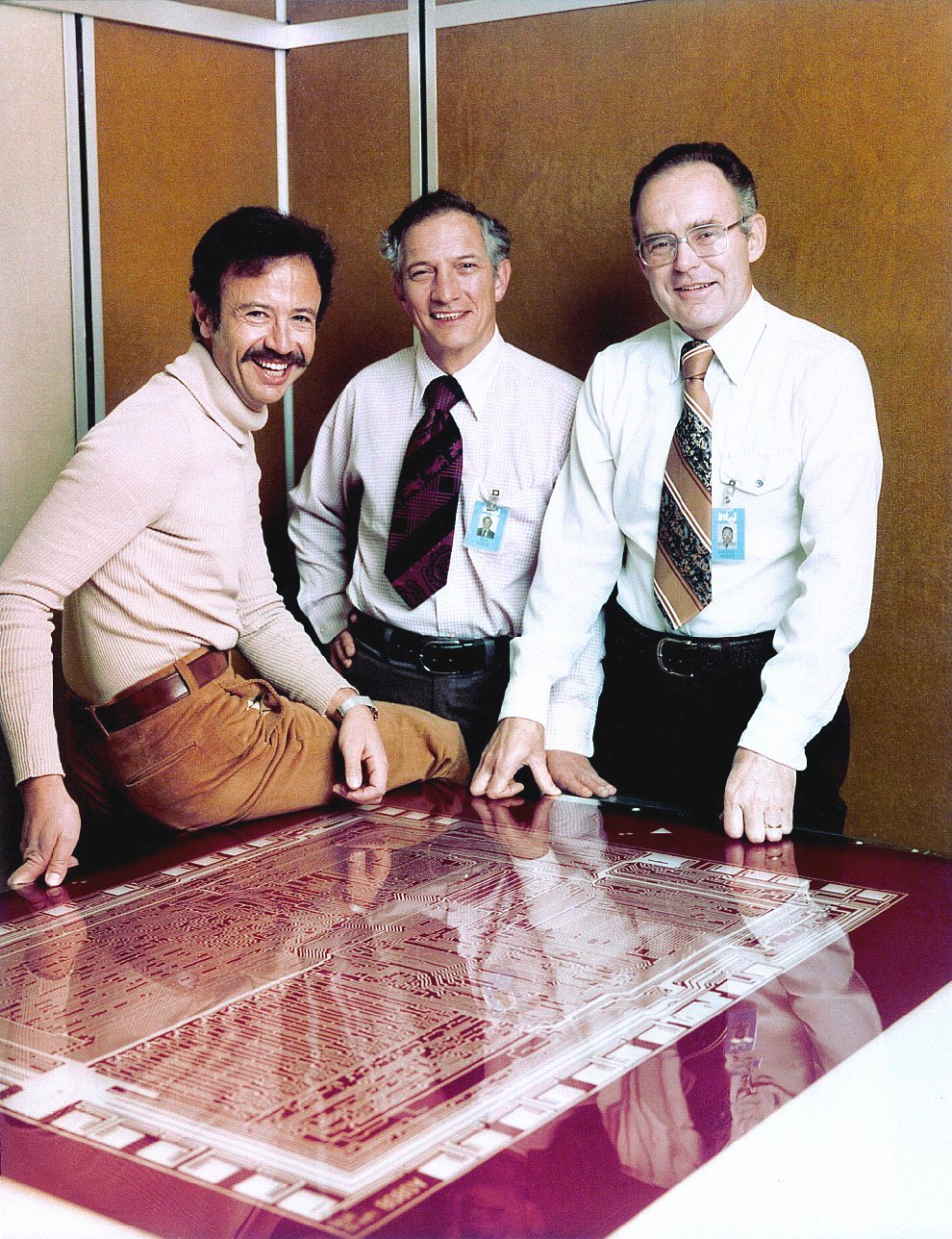
Some time in the middle of 1985, in his office in Santa Clara, Andy Grove asked Gordon Moore a hypothetical question. Grove was Intel's president and Moore its chairman and chief executive, and the company had been losing money on memory chips for three years without agreeing what to do about it. "If we got kicked out and the board brought in a new CEO," Grove asked, "what do you think he would do?" [23]
The question was harder than the anecdote makes it sound, because memory was not a division of Intel. Memory was Intel. Robert Noyce and Moore founded the company in 1968 to build semiconductor memory, and its 1103 chip, launched in 1970, replaced magnetic core memory as the industry standard [24]. The microprocessor arrived in 1971 as a side commission for a Japanese calculator maker, Busicom, and for a decade it was the smaller business [25].
By 1984, Intel's share of the market it had invented had fallen from over 80 per cent in the 1970s to two or three per cent, according to Richard Rumelt, the UCLA strategy scholar whose Good Strategy Bad Strategy made the study of strategic diagnosis a discipline [2]. Japanese producers had built more automated plants and spent more on process control, and their yields showed it. Intel's earnings per share fell to one cent in 1985 [2].
Losing money is not by itself an argument for leaving a business, and inside Intel the argument for staying was technical rather than sentimental. Memory was the company's process driver. A memory chip is a regular, repeating structure, which makes it the ideal vehicle for learning a new manufacturing generation. You run millions of them, you find out where your process is weak, and you carry that knowledge into everything else you build. On this view, selling memory at a loss was the tuition Intel paid for factories good enough to build anything else. Give it up and you would be a design house learning manufacturing from low-volume parts, which is the slow way.
There was a second argument, quieter and stronger. Almost all of Intel's factory capacity was configured for memory. A company that abandoned the product would be left with plants running a fraction of their volume, and the fixed cost of a semiconductor plant does not fall when you stop using it.
Against that sat a fact nobody disputed. The Japanese cost position was not a cyclical accident, and Intel had no plan that closed the gap.
Your call
It is the middle of 1985 and you are president of a semiconductor company whose founding product, memory, has lost money for three years. Your share of the market you invented has fallen from over 80 per cent in the 1970s to two or three per cent, because competitors run more automated plants at better yields, and nothing in your plan closes that cost gap. Memory is also how your factories learn. It is a simple repeating structure, run in millions of units, and it is where each new manufacturing generation gets debugged before anything harder goes through. Most of your capacity is configured for it. You can keep funding memory while you attack the cost gap, keep a small line purely as a process-learning vehicle, or leave the business and find another way to teach your plants. Choose, say what happens to the capacity and the people attached to whatever you drop, and name the evidence that would tell you within a year that you chose wrong.